Wednesday, February 19, 2014

As the Beaver Zeitgeist Approaches....

From Wikipedia: The Zeitgeist (spirit of the age or spirit of the time) is the intellectual fashion or dominant school of thought that typifies and influences the culture of a particular period in time.

It seems as if beaver restoration/awareness is one of those activities where the saying 3 steps forward, 2 steps back is very apropo. On one side you have the robust scientific body of evidence that beaver benefit watershed, enhance fisheries, negate drought-flood-channel incision/erosion, increase biodiversity, and sequester carbon. Management practices, i.e. living with beavers by being smarter than them, with the utilization of flow control devices, beaver deceivers, and mesh-wire to protect trees has also revolutionized the game. And for the first time beaver management can be both pragmatic, co-habitable and practical. But seemingly in lockstep with the increasing realization of these benefits are outdated management practices- dynamiting dams, trapping, killing, kill quotas- and the dilemma of, what I like to call science by assertion. 

Here is an example of science by assertion, more or less paraphrased from a discussion on beaver restoration in New Mexico. Beaver dams occur on the river upstream from my property.  We are not seeing the surface flows we once did. I can't get my historical allotments, water my crops, etc etc... the beaver dams took away the water and it is all held back behind their dams. Get rid of the beavers...

At best this is a hypothesis, albeit a hypothesis not supported by the vast amount of data regarding hyporheic exchange, water tables, aquifers, and the nature of ephemeral flows in arid watersheds. Truth be told the above statement is in fact a great example of correlation does not imply causation. In reality these lessened surface flows would be there with or without the beavers and are a result of the drought stricken west, subsurface pumping, and water diversion. If anything, beaver will allow longer sustained flows in rivers/creeks of an ephemeral nature.

Never the less despite recalcitrant outdated notions that people hold onto like cherished icons of a dying faith the beaver movement is gaining grounds slowly but surely.

Senators Seek Plan to Help Bring Back the Beavers and Protect Wetlands


Wildlife biologists contend beavers could be the most low-tech, inexpensive answer that drought-plagued New Mexico has for storing up precious water and rescuing dwindling wetlands— but some of the animals are still killed every year by people who consider them nuisances.

The state Senate is considering a memorial sponsored by Sens. Tim Keller, D-Albuquerque, and Bobby Gonzales, D-Taos, asking several agencies to develop a statewide beaver-management plan to rein in conflicts between property owners and unwanted animals and to support populations where beavers are needed. Senate Memorial 4 passed the Senate Rules Committee Thursday and is scheduled to be heard next in the Conservation Committee.
“I’d like to see New Mexico craft an intentional beaver-management plan like Utah has,” said Bryan Bird, Wild Places Program director for the Santa Fe-based nonprofit WildEarth Guardians. “It would be a solution to a lot of problems. Right now, there’s no logic to how we manage beavers.”

Of course it is not too hard to make the leap from New Mexico- semiarid, drought stricken- to California (especially socal)- also semiarid and drought stricken. I think you can connect the dots. Let's hope that New Mexico proceeds and California does not lag too far behind (like Bakersfield).


In fiscal year 2011, Wildlife Services killed or euthanized more than 27,000 nuisance or injured beavers in 44 states and relocated 177. In New Mexico, Wildlife Services has killed or relocated an average of 30 beavers a year. In 2012-13, licensed trappers also harvested 121 beavers.
Beavers lived in all perennial waters in New Mexico until the late 1880s. Their numbers steadily declined due to trapping, development, livestock grazing and loss of habitat.
Without beavers, the ponds that helped store up water on many stream systems dwindled, according to another recent study on the ecological benefits of beaver dams, conducted by New Mexico State University researchers. The study found only 40 active beaver dams on streams on public lands in the state in 2013, according to Jennifer Frey, an associate professor and one of the study’s authors. She said beaver were “functionally extinct” in the state because “they are so sparsely distributed that they are not able to perform the vital ecosystem services that would improve the health of our streams.”
A 2011 report from the state Department of Game and Fish, the USDA and the U.S. Fish and Wildlife Service said there was evidence of beavers on 2,200 miles of riparian habitat in New Mexico. Population estimates for beavers in the state range from 5,254 to 11,676 animals.
You gotta say, that is some of the best news in a while- it looks like some people are listening.
And to top that one is some real science, just published in Aquatic Conservation: Marine and Freshwater Ecosystems

Now that is a title of paper I can sink my teeth into.


ABSTRACT

  1. After near-extirpation in the early 20th century, beaver populations are increasing throughout many parts of North America. Simultaneously, there is an emerging interest in employing beaver activity for stream restoration in arid and semi-arid environments (collectively, ‘drylands’), where streams and adjacent riparian ecosystems are expected to face heightened challenges from climate change and human population growth.
  2. Despite growing interest in reintroduction programmes, surprisingly little is known about the ecology of beaver in dryland streams, and science to guide management decisions is often fragmented and incomplete.
  3. This paper reviews the literature addressing the ecological effects and management of beaver activity in drylands of North America, highlighting conservation implications, distinctions between temperate and dryland streams, and knowledge gaps.
  4. Well-documented effects of beaver activity in drylands include changes to channel morphology and groundwater processes, creation of perennial wetland habitat, and substantial impacts to riparian vegetation. However, many hypothesized effects derived from temperate streams lack empirical evidence from dryland streams.
  5. Topics urgently in need of further study include the distribution and local density of beaver dams; consequences of beaver dams for hydrology and water budgets; and effects of beaver activity on the spread of aquatic and riparian non-native species.
  6. In summary, this review suggests that beaver activity can create substantial benefits and costs for conservation. Where active beaver introductions or removals are proposed, managers and conservation organizations are urged to implement monitoring programmes and consider the full range of possible ecological effects and trade-offs.
Copyright © 2014 John Wiley & Sons, Ltd.
This paper essentially synthesizes all the peer reviewed knowledge we have about beaver in xeric habitats- very pertinent to my quest here of course. The authors take a very conservative, but I would not say negative, position on when, how, and where beaver belong- and this is a very rigorous approach as there are many mitigating factors- beaver effects on non-native vegetation, animals etc etc that should be considered. And truth be told beaver advocates, including myself,  sometimes portray beaver as a bit of a panacea- but things are complicated, especially highly human modified watersheds. But the more info the better and the timing of this paper is very promising in terms of the increasing pace of beaver restoration in arid watersheds!! Exciting times!!!

Unfortunately the paper is behind a paywall, if you want a copy just shoot me an email at duanen8@gmail.com


Santa Clara River @ Santa Paula. Duane Nash
Also, since we talk a lot about salmonids (trout, steelhead, salmon) let us remind ourselves we are in a drought and we need to protect these precious, unique, and valuable anadromous fishes.

Saving California's Salmon During a Severe Drought

and don't forget the Salmonid Restoration talks in Santa Barbara this March with a special program on Beavers!!!


Carson Jeffres (c)

Support me on Patreon.
Like antediluvian salad on facebook.
Watch me on Deviantart @NashD1.Subscribe to my youtube channel Duane Nash.

Wednesday, January 29, 2014

As the Drought Bleeds On... like Water from a Stone

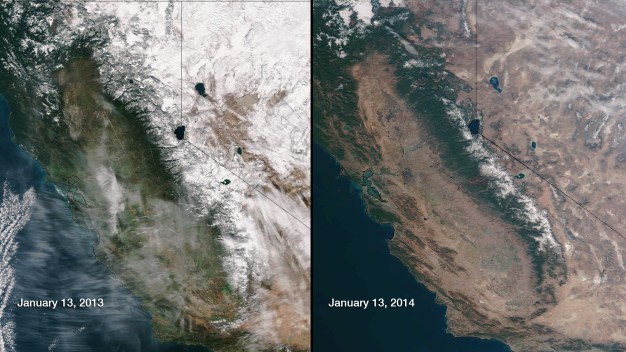
Yep, things are pretty bad here in California with quite possibly the worst drought in California's recorded history pummeling California and other parts of the west right now. A picture is worth a thousand words...
NOAA/NASA
To the left is California on January 13, 2013- a drought year but not as bad as this year on the right. In addition to the lack of Sierra snowpack, the lack of green is pretty startling as well in the picture. Yep, if we don't get any water soon there is going to be dramatic changes a-foot in terms of how this state treats it's water resources. Agriculture, golf courses, water recreation, front lawns- this state may have a wholly different appearance in the coming years if, as some are already suspecting, this drought is actually not a drought at all but simply the new normal...

And if you get out and hit boots to the ground you can easily see the crippling effects this drought is already having on the environment/water resources. Remember when I took a little beaver safari to the beautiful Santa Ynez a couple of months ago? Well I have not been there in some time but I have heard large portions of the river are dry and that, as the photo below of Bradberry dam attests, Lake Cachuma has dropped so low water outflow to the Santa Ynez is cut off.

Bradberry Dam @ Lake Cachuma (lake side facing us)
Let us hope the beaver population of the Santa Ynez, one of the best in socal, finds a way to get through this massive drought. Here is more on Cachuma lake, a reservoir that provides drinking water for much of Santa Barbara county.

Closer to home in Ventura county things are no better. On hikes through the chaparral hills I am noticing many of the normally bomb-proof plants simply browning up and failing. Scrub oak, manzanita, ceanothus- plants which thrive in our semiarid, 12-14 inches of rain environment- still need those 12-14 inches of water to survive! On the Oxnard plain in Ventura county where I live- a major agricultural hub- many of the normally bursting strawberry fields are simply being turned over and allowed to go fallow. Farmers are not getting the seasonal rains and as the aquifer plummets they may no longer be getting the historical pumping allotments, unsustainable as they were, that let them grow blueberries in the desert.

Things are bad for our friends the salmonids not just in southern California but throughout the whole state where some stocks of Coho salmon in central/northern California may go extinct.


Yep it is scary times. I would attempt to put a positive beaver spin on it- but beaver only work as water storage devices where there is at least some water there to begin with...

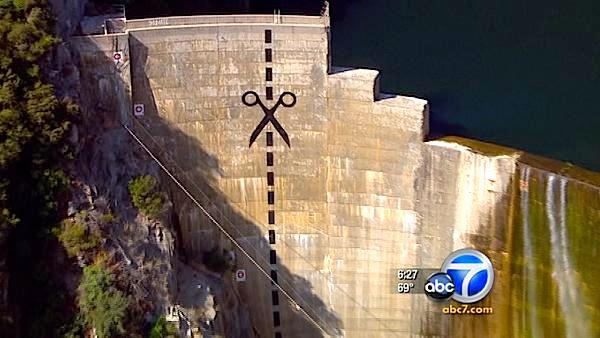
Never the less we can still hope. I recently hiked up the Matilija Creek in Ventura county. You know the one infamous for the dam that has that graffiti on it? Well the normally perennial creek was dry, until I got up higher in the drainage and found some water still flowing. Hiding out in one of the pools- a rainbow trout. Surviving trout give me hope- where trout live, maybe beaver can too...


Support me on Patreon.
Like antediluvian salad on facebook.
Watch me on Deviantart @NashD1.Subscribe to my youtube channel Duane Nash.


Monday, January 6, 2014

A Southern Californian Riparian Stream and an Amazing Video on Southern Steelhead

I want to share some photos of stream I took recently. The photos are of the Portrero John Creek located in the Sespe wilderness of the Los Padres National Forest. Although the larger stream it flows into the Sespe is actually fairly dry in several areas this time of year the Portrero John Creek maintains consistent flows, even during the persistent drought we are experiencing in California. The Sespe watershed, as I have discussed before may have served as one of the last refugia of native goldern beavers in southern California prior to their extirpation. Reintroduction of beaver into such creeks makes a lot of sense in my opinion. You will notice good riparian vegetation- willows, cottonwood - and year round flow- thats all a beaver needs. In addition to the sometimes ephemeral flows in these mountains there are also abundant predators - cougars, black bears, coyotes, bobcats - that offer much challenge in terms of establishing populations. Also keep in mind the creek is at several thousand feet of  elevation and the area is often snow covered this time of year- but it has been a warm, dry winter so far in socal.


Also if there are any botanical people out there let me know what this plant I kept finding under oaks and pines is. I think it might be a spikemoss but I can't find any pics of types that look like it found in these parts of the Transverse Range.


And finally an awesome video by cal-trout about the challenges facing steelhead restoration with beautiful clips of several southern Californian streams and rivers. Enjoy.

Southern California Steelhead: Against All Odds

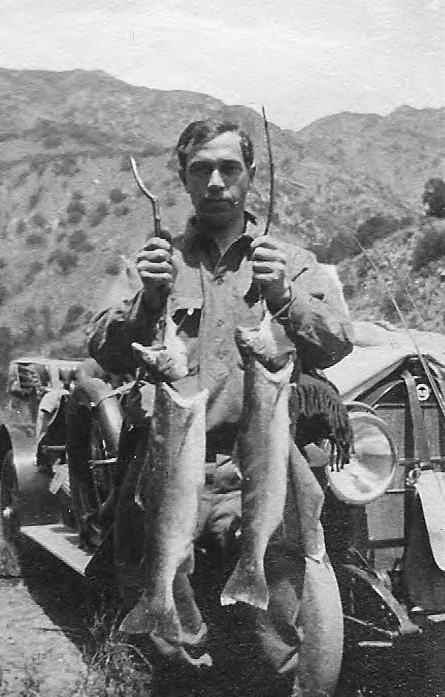
Steelhead. Sespe Creek. 1911
Steelhead. North of Fillmore  April 1983

Steelhead. North of Fillmore April 1917


Support me on Patreon.
Like antediluvian salad on facebook.
Watch me on Deviantart @NashD1.Subscribe to my youtube channel Duane Nash.

Going Cuckoo for Beaver

(c) PhotosbyJoe
I want to introduce you to a bird, a bird you may not have even known existed in southern California- the Western Yellow Billed Cuckoo, Coccyzus americana. Yes southern California actually has a cuckoo and the western distinct population segment is what we are talking about here because it has different habitat requirement than the eastern population. It is a secretive bird, predator of large insects and small vertebrates, has a distinct call, and is one of the latest arriving migrants to America from its wintering grounds in South America. It lives in deciduous woodlands and, specifically for the western population segment, riparian habitats. Areas with stands of cottonwoods, willow, and sycamore. Sounds like it prefers the habitat of something else we talk a lot about here that happens to be the namesake of this blog. And surprise, surprise it is a rare bird. So rare in fact that the U.S. Fish and Wildlife Service is moving to list this bird as a Threatened Species under the Endangered Species Act (ESA). And here is what the American Bird Conservancy group has to say about that:


"The draft rule only proposes to list the species as threatened rather than as endangered, and doesn’t address the threats or propose more effective conservation measures such as removing cattle from riparian areas and restricting the use of pesticides in adjacent agricultural areas,” said Steve Holmer, senior policy advisor with American Bird Conservancy.

But wait there is more:

"Federal agencies must address water diversion and grazing policies that are disastrous to the cuckoo. They need to reverse direction, stop the degradation, and develop a plan to restore riparian areas and regrow lost Yellow-billed Cuckoo habitat," Holmer added.

Ok so it appears this bird has a lot of obstacles in its way. Getting agriculture to go pesticide free, not likely for big agriculture. Removing cattle from riparian habitats, again gonna be a tough one. But that last sentence: "They need to reverse direction, stop the degradation, and develop a plan to restore riparian areas and regrow lost Yellow-billed Cuckoo habitat." That last bit about restoring and regrowing riparian areas yeah beaver can take care of the that part. The pesticides and the cattle- that is difficult but restoring the habitat beaver can go a long way towards that end.

Hopefully you are seeing a theme here. Steelhead salmon, yellow billed cuckoos, western pond turtles, red-legged frogs, willow flycatchers and even the beaver themselves- it is not really about any one of these species individually. It is about finding the most economically sound, viable, repeatable and observable tool that can at least give all of them a fighting chance- let the beaver do the work of habitat restoration for us.

The U.S. Fish and Wildlife Service is taking public comments on the listing of the western distinct population segment of the yellow billed cuckoo until February 24, 2014. I suggest you drop by and give them your thoughts.

Ventura River riparian forest

Support me on Patreon.
Like antediluvian salad on facebook.
Watch me on Deviantart @NashD1.Subscribe to my youtube channel Duane Nash.


Sunday, November 24, 2013

The $2.1 Billion Dollar Question

Environmentalism, stewardship of the land, ecology and the Endangered Species Act. These are all words, concepts, and laws that have become more or less entrenched within left leaning circles. The "bleeding heart liberal" with bumper stickers that say Keep Tahoe Blue on his/her Prius is more of a posterboy for environmental concerns than the guy with the NRA sticker on the back of his Ford Pickup. But this modern political separation, this bipartisan split, is not historically reflective of environmental attitudes in this countries past.

As Rick Meril at the excellent blog, Coyotes, Wolves, and Cougars.....Forever!!! pointed out in a recent post bipartisan support of endangered species acts and clean air, water and land conservation efforts were at one point in this countries past supported by both republicans and democrats. Remember that it was Nixon who signed the Endangered Species Act into existence. So when did the schism occur? Blame Reagan, who in the 1980's elected James G. Watt as the U.S. Secretary of the Interior.
James G. Watt. wiki

Now not only did Watt posit environmental regulations and concerns as a chief deterrent to economic wealth and prosperity but openly cited his Dispensationalist Christian faith as informing his environmental methodology. The alleged quote "After the last ree is felled, the lord will return" is attributed to him. Although there is no actual proof he said this, the quote is not too far off the mark with regards to his track record. Together with the head of the EPA, Anne Gorsuch Burford, the duo set the standard for Republican attitude towards environmentalism. A standard that, unfortunately, continues to this day.

What often gets lost in the discussion, when acts such as the endangered species act are cited as a deterrent to economic vitality is this: That the endangered "little fish" or "stupid frog"  is actually an emblem for an entire ecosystem. These canaries in the coal mine are just the first in a whole network of species to show outward signs of distress, while in reality it is the whole biological network- the community as a whole- that is in decline. Secondly industries shift, move, and go extinct themselves. Take the city of Detroit for example. So if the air, water, and soil of a land is poisoned in the name of industry, when that industry moves, implodes or disappears- now that land is good for nothing. No hunting, fishing, hiking, recreational sports, or agriculture. Good for no one.

A little less than a year ago this article ran in the local free paper, The Ventura Reporter: Restoring Steelhead to Cost Up to $2.1 Billion Over Next Century. Now the fun part about this article is, of course, the comments section. Having a strong republican flavor here- Simi Valley and several naval bases call the county home- you can well imagine the furor such an article would stimulate. One of my favorite pro arguments is that the 1.2 billion dollar price tag is the equivalent of a B-2 stealth bomber, but unlike the bomber- steelhead are edible.

But again what gets lost is that $2.1 billion is actually about not just the steelhead- but restoring the ecosystem as a whole- there are several other state and federally threatened/endangered species that would benefit from the steelhead recovery effort. And if you want to take a look at the recovery proposal from NOAA here is the link.


What should be apparent to readers of this blog is that the watersheds that house steelhead and are proposed as recovery areas are the exact same watersheds I and others advocate for beaver restoration efforts. Now you  would not need $2.1 billion to restore beaver into these watersheds. Hell, $2.1 million might do the trick just fine. I'm just saying, bang for your buck, beaver restoration- coupled with some nice dam removals and Arundo donax round ups might be the best bet.

Matijilla Dam in Ventura County. Scissor graffiti is real
If you want to restore steelhead- you have to restore the whole watershed. And if you have to restore the whole watershed the most economic and pragmatic approach is to let beaver do it for cheap. They for sure have the lowest bid among the government contractors. They don't have a union. They will do it better than the government and will do it for cheap. And isn't that what republicans always claim to want: less government and cheaper?

From the NOAA paper:

"Recovery of viable, self-sustaining populations of southern Steelhead will require a shift in societal attitudes , understanding, priorities, and practices and ultimately the reintegration of the species into a highly altered landscape that is home to more than 22 million people."


A little touch-feely but good vid by EDC on Santa Barbara based Mission creek steelhead restoration with groundbreaking culvert retrofit.

Restoring Steelhead to Cost Up to 2,1 Billion Over 100 Years. VCS. 1-12-12


Support me on Patreon.
Like antediluvian salad on facebook.
Watch me on Deviantart @NashD1.Subscribe to my youtube channel Duane Nash.

Wednesday, November 20, 2013

Reclaimed Water for the Win?


Looks like a nice little meandering river, no? Nice riparian vegetation- loads of willows, cottonwoods, sycamores- good flow for a southern Californian stream deep into the fall before any rains have commenced. Surely such an inviting scene is miles away from the machinations of modern man. But that little road way may tip you off otherwise...

What you are looking at is a section of Conejo creek downstream from the Hill Canyon Wastewater Treatment Plant of Thousand Oaks. Of course I have mentioned this watershed before. Conejo creek has received some press recently due to the revelation that the federally protected southern steelhead has begun to recolonize these waters. The cities of Thousand Oaks and Camarillo both discharge treated wastewater into the creek. And in light of the fish's presence in the creek both municipalities may now be required to sustain these discharges in order to maintain the habitat. And this is much to the ire of at least Camarillo, because that city had begun construction of a pipeline to use their reclaimed water for agriculture (probably sod farms as I don't think reclaimed water can be used for food crops).

And this whole debate is one which we have visited upon before: In a landscape that has historically been robbed of water flow through dams and diversions, is it now our obligation to recoup some of the  losses by taking advantage of outflow from wastewater treatment plants? I know it is not a pleasant thought, concentrating wildlife restoration efforts in essentially treated sewage. But as I said before, in a water parched landscape, beggars can't be choosers. And ultimately, it is not our choice to make- wildlife is already making the choice to live in habitats made possible through reclaimed water discharge- such as the steelhead recolonizing Conejo creek or the waterfowl I photographed in some of the tanks for the treatment facility in the picture below.


And I mean, it really is a nice looking stream when you get over the "treated sewage" aspect of it...


Of course all of this talk of treated effluent begs the question: should we concentrate beaver restoration in these areas in southern California? Well I would say YES! YES!! and more YES!!!

But let me buffer my argument more with this line of reasoning. To reestablish beaver they need to get over the predator hump. MartinezBeavers talked about this issue recently here. While beaver have been extirpated from many parts of their former range, their natural predators-cougars, bobcats, coyotes, bears, wolves- have done quite nicely in the meantime. Jeff Baldwin of Sonoma State addresses this very real issue of the problem of beaver reintroduction in predator saturated lands. It becomes less to do with stream slope gradient/vegetation type and more to do with how will this beaver transplant survive in small streams before it can build dams to survive predation? There is a real potential for loss in restoration efforts especially in arid lands with small streams and abundant predators. So the real question becomes how do we maximize our chances of successfully reintroducing beaver into these lands? Well we need to look at beaver restoration as essentially a war- there will be heavy casualties beavers will absorb, no doubt about it, from people and predators.

Okinawa beachhead. 1945. wiki
But if we utilize the areas of deepest water and highest flow- often man made reservoirs, dams, and water reclamation outflows- we will stand the greatest chance of establishing beachheads. And from these beachheads beaver can then spread across the whole watershed.

N. Matijilla Creek. Los Padres Wilderness

Middle Lions Camp. Sespe Wilderness
Above are two places I would love to see beaver reintroduced. The north fork of Matijilla creek is a tributary of the Ventura river and still has steelhead while Middle Lions camp also has a stream in it with steelhead. In the case of Lions camp I have it on good record that an acquaintance of mine, Tim Peddicord a retired biology teacher, spotted a beaver there in the 1960's. Additionally numerous other anecdotal reports of beaver in the Sespe watershed suggest that this area was a final stronghold for beaver in southern California.

However the Sespe wilds might not be the ideal spot to reintroduce beaver initially, as appealing as it may seem. That name, Lions camp, is no joke- there are lots of cougars out there, and bear, and coyote, and bobcat. The flows might be low or the pools just not deep enough to establish beaver in high enough densities to get over the predator hump out in the Sespe.

But how about a place like this:

Santa Clara River Estuary
Although the lower Santa Clara river runs dry due to the Freeman Diversion the estuary forms a veritable lake due to discharge from the Ventura wastewater treatment plant. Dense beds of tules and acres of willow thickets would be ideal forage. No cougars or bears here. Establishing a viable population would be possible and from here intrepid beavers could spread up into the entire watershed or be transplanted by humans to other areas in the watershed.

We just have to get over the "icky" reaction to treated wastewater- the wildlife already has.

Conejo Creek
Support me on Patreon.
Like antediluvian salad on facebook.
Watch me on Deviantart @NashD1.Subscribe to my youtube channel Duane Nash.


Sunday, November 10, 2013

Beaver Wars: the Social and Scientific

Okay, it has been a little bit of time since I have been on here. Unfortunately the interesting algae I found in the Santa Ynez river was verified as Nostoc by an algae specialist- so not a new species.
Busy with my other blog and various shenanigans. But things have been busy in the beaver world none the less.

Beaver work is as much about the social as it is about the scientific. Getting involved with beaver restoration/outreach has taught me a lot about humans and how slow and sometime incapable of change we can be. Even in light of damning evidence.

Let's go over some of the news.

Bakersfield Beaver Wars

Bakersfield is actually a quite large city in the San Joaquin Valley of California. Its most notable exports are oil, methamphetamine, and the nu-metal group KoRN. Of the three cultural touchstones that Bakersfield has produced KoRN might be the best one- but not a lot of competition there. But Bakersfield does also have beavers, which started arriving at various municipal waters most likely via the Kern river at about the same time that the well documented Martinez beavers started showing up. But this where the two cities paths diverged. While Martinez, especially through the work of Heidi Perryman/Worth a Dam/Martinez Beavers, has provided a model and precedent for how municipalities can live with beaver Bakersfield has opted to go for a less progressive and scientifically less robust method of management. While public outcry has forced trapping/killing measures to be curtailed or implemented in clandestine they have initiated a redundant policy of plastic wrapping park trees as opposed to wrapping them in wire. I'm sorry, but those incisors will cut right through that plastic.


Wikipedia Creative Commons


Chew on this: The bike path beaver is back. The Bakersfield Californian. Nov 4, 2013.

In the article above the reporter makes the dubious assertion that one rogue beaver is returning over the years to terrorize city landscaping. More likely the beaver(s) are moving on or being secretly killed while new emigrants arrive all the time. If a natural vegetation of willow/cottonwood/tule/cattails was allowed to flourish the vegetation could better cope with beaver modification through coppicing. Unfortunately, expensive non-native landscaping is insisted upon which can not root sprout. Face palm.

Beavers return to Park at Riverwalk. 23 ABC News. Nov 4, 2013.

'First Look': Beavers spotted and Scott Cox's solution. The Bakersfield Californian. Nov 4, 2013.

And it gets worse in the article above.

So what do you do in the face of such will full ignorance? At least you can connect with the links above and comment. Go for it. Heidi has done all she can to promote beaver tolerance to the city and seems to be at her limit. More voices need to chip in.

It is shame that Bakersfield is missing a golden opportunity for embracing beaver within a large metropolitan area and setting an example to other cities. But I guess they are happy being the city where KoRN came from.

KoRN. wikipedia


Martinez Beaver (c)


A Really, Really Bad Article: Rip it to Shreds

I don't know where to start with this one... Is it simply clickbait? In the information age we live in I can't grasp how so much misinformation/non-science gets propagated.

11 species that are destroying the planet. Salon. Nov 9, 2013.

If the press will not do their job and they continue to profligate sloppy, hackneyed assertion science we need to shame them into doing their job.


Support me on Patreon.
Like antediluvian salad on facebook.
Watch me on Deviantart @NashD1.Subscribe to my youtube channel Duane Nash.