Well all-righty then the conference is over and I have had a couple of days to digest all the things I saw and learned. The venue was awesome, Santa Barbara breathtaking, and the salmonid restoration federation (SRF) did an outstanding job with organization, breadth of presenters, and even the food/coffee/snacks offered up, including a lunch, exceeded expectations. I do intend to get to the talks I saw on Friday and Saturday but today I want to finish up on the beaver/salmonid workshop and field tour because, you know, beaver... and salmon.
Historic and Current Distribution of Beaver In CA. CDFW Lanman et al
But first a couple of thing with regards to the blog. Coincident with the recent publication by CA fish and wildlife paper Lanman et al documenting the historic occurrence of beaver though out the majority of California and the conference on beaver/salmonids my little blog has seen a slight uptick of visits. Granted beaver in semi-arid socal is a bit of a niche blog market anyways- the average socal brah is probably ignorant on beaver in socal, or southern steelhead for that matter- it is still encouraging to see daily page visits go up from a trickle of 3 or 4 visits to getting up in the double digits on the reg. Additionally I discovered a facebook open group Beaver Management Forum where I put my posts and that has helped with attention too- make sure to join!!! And you too can help southland beaver as well simply by liking my posts on facebook- even if you don't read them haha- or sharing on on your wall it all helps.
Martinez Beavers. c/o Ted Guzzi
Now back to the beaver workshop. It was great to meet and talk to so many beaver believers (sorry Justin we are taking the name back). People like Martinez Beavers own Heidi Perryman, "Rickipedia" Rick Lanman, and the Water Institute's Kate Lundquist and Brock Dolman. I also met and had nice conversations with Eli Asarian of Riverbend Sciences/beaver mapper, Shari Witmore of NOAA, Kevin Swift of swift water design- an emerging player in California non-lethal beaver management- as well as beaver advocate and water lover- great website/blog I will put it on my blogroll Kevin!! Several people also approached me and said that they do read my blog- cool!! I was a little disappointed that I did not come across any other significant beaver advocates from the southland- it was a decidedly northern Californian lot there- but you know I just got to hold it down until the rest of the southland catches up. There were loads of people I never got a chance to talk to that I would have liked to chatted up. Sometimes a lot of social contact shuts me down or I just get too shy. Never the less it was great to see such a significant beaver coalition present and as one salmon person said to me "beaver people are taking over this convention!" Well as one prominent salmon speaker said to me, paraphrasing: "us fish people can get a little myopic in our view, we do that well." So maybe beaver hooliganism is the shot in the arm that fish people need.
Duane Nash
In my last post I wrote about the first four talks at the workshop. Here I want to talk a little about the last two talks as well as the field tour.
Kate Lundquist. Martinez Beavers c/o Ted Guzzi
Kate Lundquist of the water institute gave a speech titled Policy Opportunities for Working with Beaver in Salmonid Recovery. The emphasis of the speech was actually on policy regarding beaver. A dry topic and one not as sexy as say how beaver dams serve as incubators for coho smolt or beavers role in dryland watersheds- but actually this talk was probably the most necessary in light of how beaver can and should be treated in the future in California. Basically there is not much to protect beaver in California. You can go read the CA fish and game code here. From Nov1-Mar 31 you can go out and hunt and bag just about as many beaver as you want. Additionally if you have a "nuisance beaver" you can apply for a depredation permit at any time of year- although in most rural areas it is probably safe to assume that first step is skipped. Now this may seem a bit depressing for an animal that we are trying to promote and distribute across the state but there is a silver lining in that the laws, or lack-there-of, concerning beaver in CA, offer some avenues towards change in a positive direction.... good job Kate!!!
Mike Callahan. Martinez Beavers c/o Ted Guzzi
Next up was Mike Callahan of beaver solutions, a well known innovator on non-lethal management of beaver. He showcased some nice designs with video of flow devices that allow fish to move through a box apparatus (lower flows) and then into the pipe itself and through the dam. Cool stuff and great to see this innovative design. Flew in from Massachusetts- what a rock star!!!
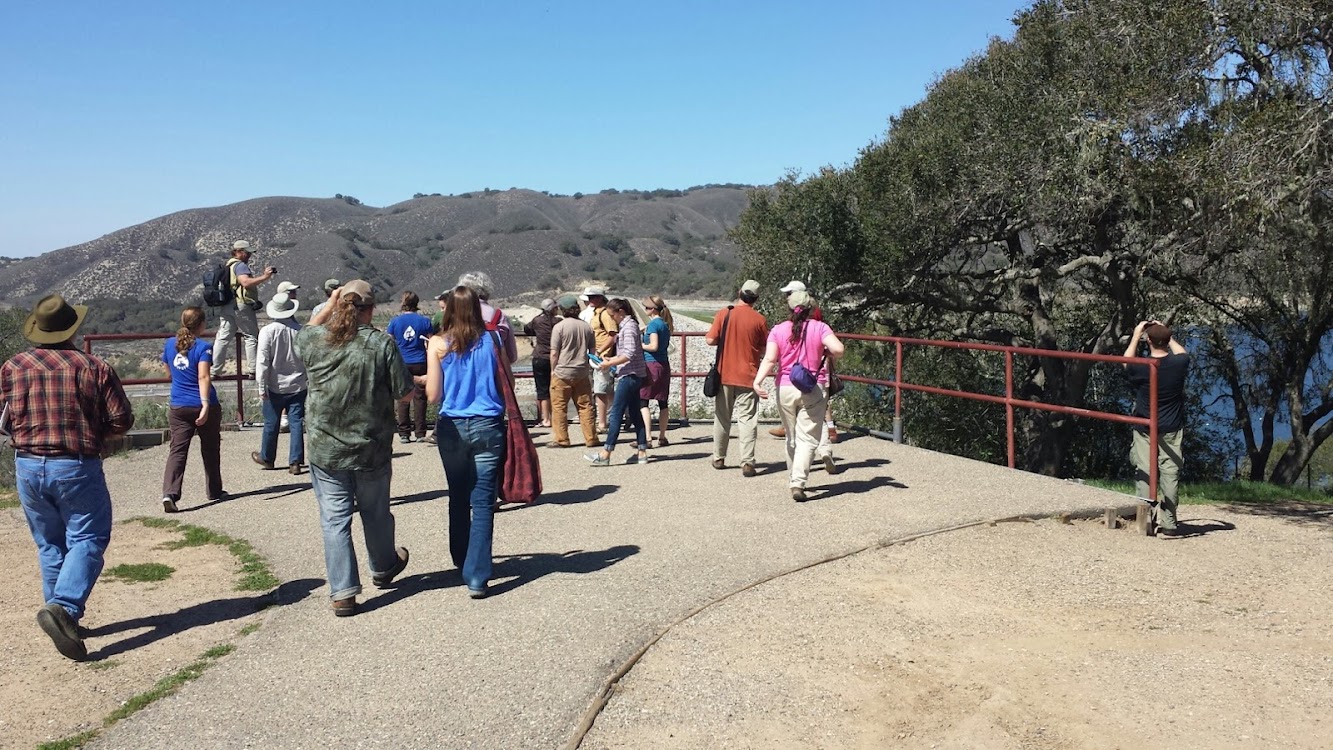
After lunch we headed off in caravan of jeeps and truck into the Santa Barbara back country for the Santa Ynez beaver tour. The Santa Ynez river is roughly cut in half by Cachuma dam which disrupts steelhead migration into the majority of tributaries and also inhibits the high velocity flows that would characterize this river system. And these two modifications are important to keep in mind. Tim Robinson, who has to balance the needs of fish, citizen water, and downstream water rights, often times is in, shall we say, a bit of a pickle. You see since the majority of good spawning tributaries are cut off by the dam the Cachuma board tries to maintain a nearby tributary and parts of the main channel with year round flows of, if I recall 2.5 cubic feet/second as a compromise to the loss of great steelhead habitat upriver from the dam. Which is a bit funny because, generally speaking, steelhead don't really use the main channel for spawning but as a "highway" to get to the cooler, smaller mountain streams with good gravels. So when beaver dams cause fines to build up, or water does not get to where it needs to go fast enough, or bass, bullfrogs, catfish, and carp proliferate, or flows can not be released to mimic natural flood conditions and blow out dams for water/fish movement guess who gets the blame? Yeah Tim is not as happy with beaver as many who see the benefits of beaver in less modified habits are but Tim has a definite mandate- and that mandate is for the benefit of steelhead and downstream water rights- not beavers. But all the negatives attributed to beavers in this watershed are, if looked at closely, a corollary of the inherent anthropogenic modifications to the system.
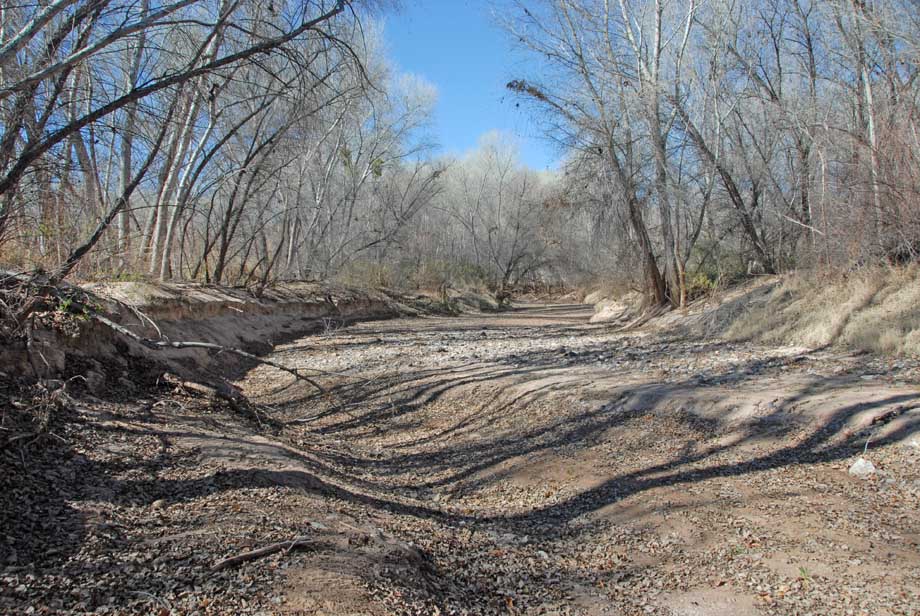
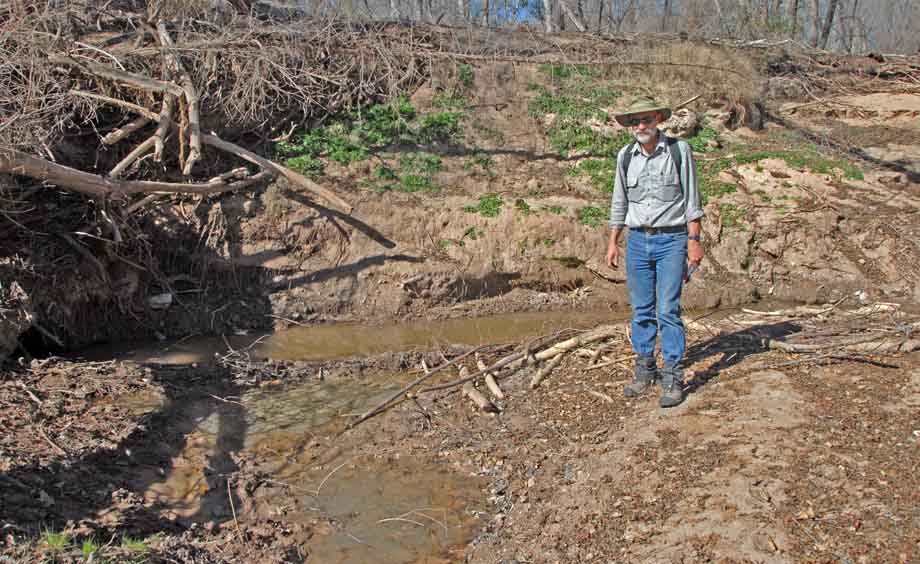
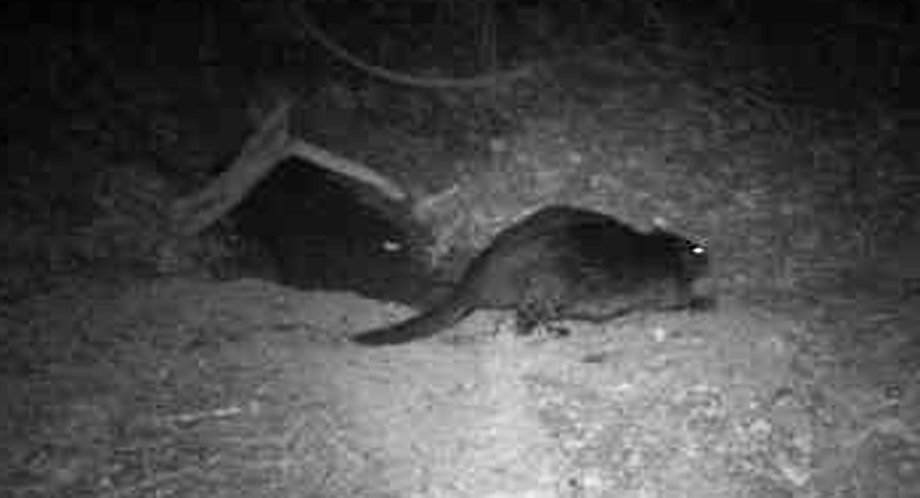
The above video is from a beaver dam south of the 154 bridge (so it does not get guaranteed year round flows) and directly upriver from the Encantado pool, a pool which becomes a veritable fish haven and sometimes killing grounds during the dry. Tim's speech and the questions are very pertinent and summarize a lot of the issues surrounding this intriguing watershed. As I mentioned to Rick Lanman later, Santa Barbara needs and can probably afford (hello SB county resident Ophrah) a desalinization plant. You may notice the dour look and vibe of many of the people. The water is low and warm. Not good trout habitat. If alluvial groundwater is not exchanging with beaver ponds due to lack of scouring flows or because of too much groundwater pumping- hyporheic exchange, where cooler subsurface flows intermingle with surface flows, one of the best attributes of beaver ponds - may not be occurring to the extent we should want. But I would not be so quick to assume this drought, and the low flows on the Santa Ynez spell doom for these beavers. Because they have lived here for 80 plus years since reintroduction. Because they live in much warmer/drier climes such as in the Mojave river and San Pedro river in Arizona. Because as I have had to correct several "trained" biologists (even at the conference) beaver do not eat fish, are amphibious but do not need to be immersed in water to live. Just look at these pics I stole from a site about the wildlife of the San Pedro river in Arizona. Read the account here.
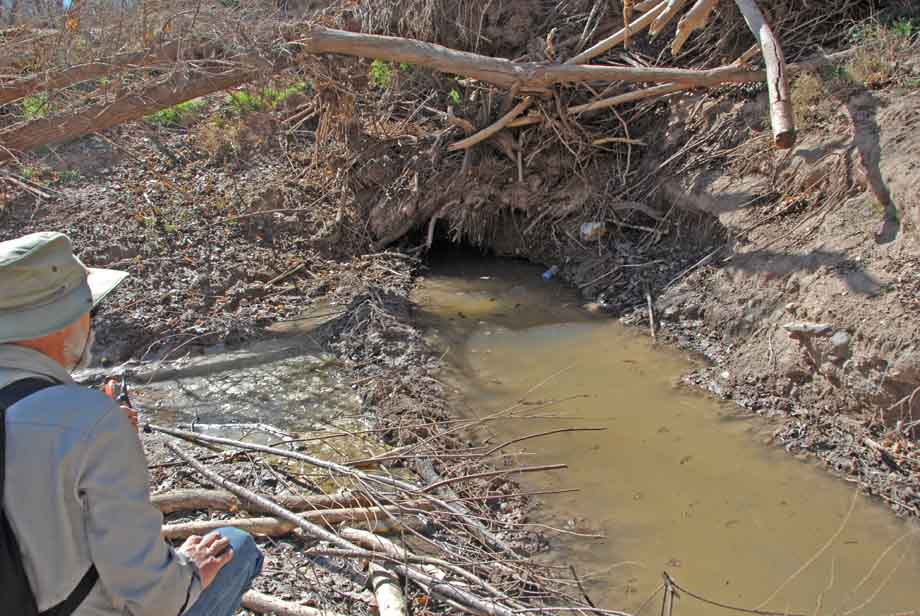
Evidently a pair of beavers moved into a stretch of the middle San Pedro that usually flows underground, built a burrow, dug a canal for water, and then went about their business building a dam for flows that were not even there yet!!
Downstream from den
Bank burrow to the left with dug out canal. Pretty much just for drinking water?
Another view into the bank burrow
But they start making a home anyways...
And when the flows returned they had this!!!
San Pedro Beavers. like bandits in the night
Unfortunately, due to time constraints we did not visit the Alisail bridge stop in Solvang. But if you want to see what the beaver are doing there, during high flows from water release I assume check out my post Beaver Safari on the Santa Ynez River from September 2013. I did notice a lot of the dams have that u-shaped berm to them that was commented upon in the video. Also in that section I noticed a lot of the dams only corralled a little side channel of the river- not the whole river.
So don't cry for the beavers of the Santa Ynez, they will get through this. However the steelhead, not so rosy looking for them...
Tim took us to a tributary of the Santa Ynez, Salsipuedes creek- which basically means "get out if you can!" referring to the heavy floods and scouring flows that pummel this creek and incise the banks. It is one of the best remaining steelhead creeks and we saw several fish passages installed. One of which, you can see in the clip below, is often times filled in by a beaver dam. Through no fault of its own, the beaver hears flowing water and sees a great spot to make a dam on a human-modified substrate and conflicts occur. Again, if team human was not perturbing the system there would be no need for a fish passage up a concrete rampart and therefore no need to demolish the beaver dam. Oh team human, why can't you play fair?
It was quite the explosion of beaver supporters crossbred with salmonid workers today at the workshop for beaver/steelhead & salmonid interactions. What a fine pedigree of people attending displaying a wealth of knowledge at the intersection of all things anadromous, finny, furry, and buck-toothed. The building itself is the spanish villa styled senior center on the waterfront in beautiful Santa Barbara CA. Only a stones throw from where I live in Oxnard CA I was able to drive there. Lucky me as others attending came in from as far away as Massachusetts!! This was the first workshop of its kind put on by the salmonid restoration foundation and as far as I know the first seminar/workshop highlighting the juncture of beaver and anadromous fish.
The first talk was by Rick Lanman (Institute of Historical Ecology), who spearheaded the recently published paper on the historic range of beaver in California. It was a well executed speech, also getting into some of his past work on beaver dams in the high sierra. One thing that was new to me was how important the steel trap was in extirpating beaver. And this extirpation, Lanman maintains, was not always committed by English and Russian fur trappers- but by the native Americans who got access to this deadly new technology. Rick also went further into the interesting semantics that for so long confused historians looking at the historical record for beaver clues. Spaniards referred to beaver as las nutrias- Spain itself having had its population of beaver long extirpated -not as Castor. The Spanish wrote of nutrias marinas- sea otters -and fresh water nutrias- which you might think implies fresh water otters -except that the record for fresh water North American river otters south of Monterey Bay is... nonexistent, and that leaves you with beaver. Not to mention the fact that these nutrias were described as dam builders. Well done Rick and coauthors, a job well done.
Eli Asarian (Riverbend Sciences) dovetailed into a discussion on the current distribution of beaver in California. He is a coauthor on the Lanman paper and works primarily in northern Californian watersheds. Eli presented loads of nice pics on beaver dams as well as presenting some data on juvenile coho/steelhead using beaver ponds as rearing ponds. Eli also has done some crucial work spearheading beaver mapper, an invaluable tool allowing scientists and citizens to document beaver sightings and document their expansions. He also hinted at some new and exciting work on beaver and salmonids coming down the pipeline!! Good job Eli!!
Next up was Heidi Perryman of Worth a Dam and Martinez Beavers. I also like to call her the CNN of beaver because she is a bit of touchstone for all things beaver. Her presentation was basically a summary of the 6 years of citizen science that she and her group have been doing in Martinez CA. I like that she took a stand and said we are not tagging these beavers. Plenty of good observational science can be accrued without alien abductions, I mean tag and release studies!! Thanks for coming down and presenting Heidi!!
The next speaker was Michael Pollock, a heavy hitter in the world of beaver/salmonids and is one of only a few published authors looking at this interaction. He gave a nice review of our knowledge of the interaction of beaver dams and salmonid passage and basically concluded... more research is needed. How very sciency of you Michael, just kidding- his talk was basically favorable to beaver and salmonids cohabiting, especially coho and steelhead being the best jumpers. But in addition to jumping salmon can swim over and around dams with appropriate flows. He also made a very pertinent statement regarding watershed health to paraphrase: the more complex, the more difficult to measure a habitat is, the healthier it is. Chew on that one kiddies. For me that means if a watershed has deep quiet pools, fast ripples, side channels, ox-bow lakes, deep parts, shallow parts all jumbled about and mixed together that is a good system. And beaver can help in those regards. One thing that Pollock stated that did get my attention is the concern that beaver dams might hold-up or delay downstream migrating smolt. While in some populations/species I can see why this is a concern, in the case of the southern steelhead, a unique population of steelhead and the most behaviorally plastic of all steelhead I think that this presupposition warrants further analysis. Let me elaborate: It is now generally understood that downstream migrating southern steelhead get through the main channel, which may usually go dry in socal, and arrive at the lagoon/estuary often times blocked from the ocean by a beach berm. They then come to size in the relatively rich feeding ground of the estuary and move into the ocean when the
time permits. However, as recently happened in the santa clara estuary, if these estuaries are breached prematurely steelhead might be left high and dry. My point is that if downstream migrating smolt found a beaver pond to their liking- that gives them another option besides the estuary to grow up in. Something to think about...
Next up was Tim Robinson, MC for the event, and also the man tasked with balancing the needs of the citizens of Santa Barbara county, Cachuma reservoir, fish, agriculture, difficult landowners, invasive species, and beaver on the Santa Ynez watershed. His was the most guarded speech as goes the benefits of beaver to highly modified, Mediterranean climate watersheds. From his perspective I can see where he is coming from. The Santa Ynez river is a little strange in that Lake Cachuma, a man made reservoir, effectively cuts off half of the watershed to steelhead. What is left is the main channel and several tributaries, most notably Salispuedes creek as steelhead habitat. Due to the inability of steelhead to get up to the majority of their historical spawning grounds Tim and the Cachuma water group are trying to maintain the main channel of the Santa Ynez as a habitat for steelhead spawning. And as you may know this is not really how the southern steelhead works- the main channel is simply the avenue used to reach tributaries for spawing. So criticisms that beaver dams spread non-natives, warm the water, or spread sediment in the main channel really fall a little flat in light of the fact that steelhead don't treat the main channel as the spawning grounds- they want the cooler mountain tributaries. Secondly the other indictment on Santa Ynez river is that flows are not reached that blow out the beaver dams. Again, in this modified system, Lake Cachuma absorbs a lot of these flows so that the full potential fury of this river is never reached as it would if the dam was not there.
Anyways I will continue with my thoughts on some more speeches and video shortly. Including two more speeches and the Santa Ynez beaver tour!!!
Ok full disclosure, I have never seen a live wild beaver before. I am a beaver virgin. I know, funny I write a beaver blog? So in order to rectify this I set out last Friday to the nearest river system that I know has them, the Santa Ynez River in Santa Barbara county. Now technically speaking this area of California is considered part of central California but it harbors a climate regime and rainfall pattern not too dissimilar to the river systems in southern California proper that I and others are advocating for beaver reintroduction. So long story short, there is much to be gleaned from studies of this thriving beaver population with respect to how beavers fit into southern Californian watersheds.
Santa Ynez River. Solvang CA
Driving through the cute Danish village town of Solvang I was greeted by the majestic river as shown in the pic above. Prior to my drive out to Solvang I did a little internet sleuthing to get an idea on where on this 92 mile river I would be likely to find beaver. Now I do not want to give up my exact location, but you can find out where to go if you look hard enough (or just contact me). The beaver on the Santa Ynez River are thought to be descended from an initial restocking done in the 1940's by the Department of Fish & Game (now Fish & Wildlife). So they may in fact not represent the true "golden beaver" subspecies of beaver in California. That being said the whole idea of beaver subspecies may be a little overstated. Beaver that live at sea level in the Sacramento delta seem to do fine at 10,000 feet in the Sierra Nevada. Beaver just learn to adapt. All they need are trees and water. Which as the photo above attests this river has plenty of (for California at least, I recognize people from back east will call this a creek). And about that water, many other river systems at this time of year have much lower flows during late summer/fall. I believe the Santa Ynez allows substantial late season discharge from several of the dams along its course for fisheries purpose (ref needed). This river historically and currently has the best southern steelhead run in California.
Beautiful river, no? Good healthy riparian vegetation including willow and cottonwood trees, two beaver favorites and nice tule thickets. And, at least in the stretch I investigated, no invasive Arundo donax, the ubiquitous bamboo looking, water sucking, flammable, inedible, outcompeting the natives, scourge of southern California watersheds. All in all seems to be a promising river with good flows and nice vegetation- where are all the beavers? Well truth be told, I was not actually expecting to see a live one- but beaver sign would be still be a success in my books. And this is what anyone looking for beaver should expect- you will not see them but if you look carefully you can find their sign. And you will probably get wet, muddy, cut up a little and maybe get a tick or two. That's why I call it a safari.
A little further upriver and I came across this large pool, maybe an old abandoned dam? In the picture as you can see was someone casting a line. He and his girlfriend were a little surprised to see me tromping through and even more surprised when I told them I was looking for beaver. Even though they are local they were not aware of beaver in the river. I asked him if he was having any luck with fishing and he quickly said he was just messing around and he didn't see any fish. Perhaps aware of the heavy fine for catching federally protected steelhead he was a little wary of me. Regardless I myself did not spot any fish, steelhead or invasive bass/catfish, myself but loads of mosquito-fish. But it is too late for steelhead to be migrating and perhaps too warm in this stretch anyways. He did inform me that a little bit upriver the vegetation gets pretty thick and the river disappears into it. That was a promising lead my friends....
I pushed forward into the riparian jungle, more determined than ever to find evidence of Castor canadiensis. I made my way through a debris flow from the last storm season, disturbing a nest of rats. And then things started to change, the river was increasingly obscured by vegetation, disappearing into a tangle of willows, tule, and muck. I saw that instead of a well defined river bank like I had observed so far, the water was slowing down and backing up, creeping up out of the thicket. Suddenly a large flock of red-winged blackbirds. A great blue heron. Every couple of hundred feet I would hear the gurgling sound of moving water. Well now or never, time to dive in and see what is causing the sound...
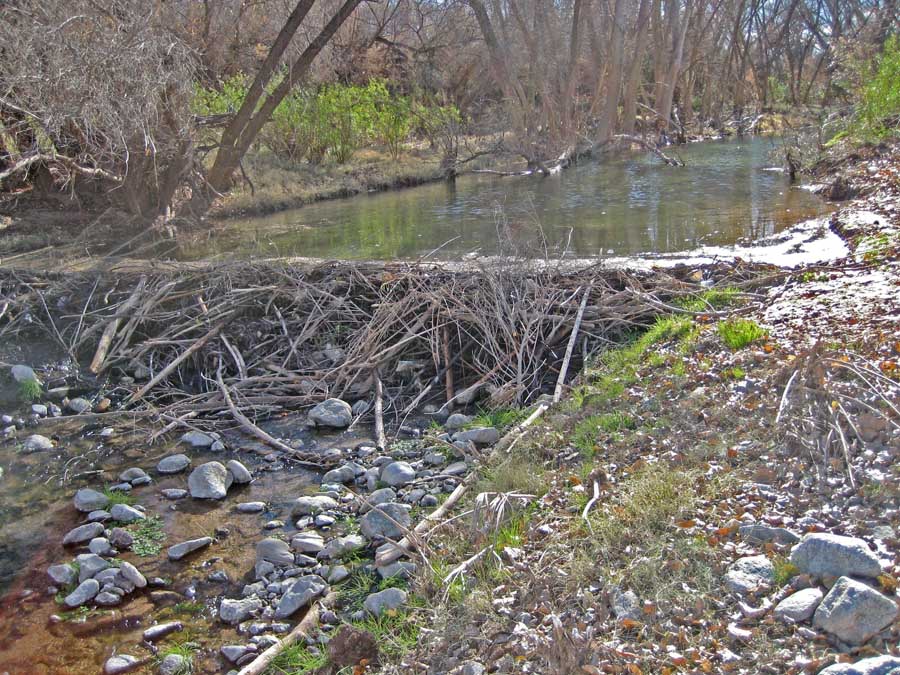
And there it was my first beaver dam. Obviously not the massive behemoth structures you see on nature documentaries but here it was regardless. What became immediately apparent was that there was not just one of them however. It seems the beaver(s) had diverted a portion of the rivers flow into these little side channels so that they could more easily maintain the water. Each little micro-dam, all of which allowed some or much water to flow through, formed a series of little step dams. The effect of which was to slow down and spread out the water and also allowing tules, willows and other riparian vegetation to get a good toe-hold on the banks.
Ok, maybe some of you are thinking that those little "micro-dams" might just be naturally occurring little snags of dead vegetation forming at specific choke spots on the river, fair enough.... But what about this...
and this...
and this...
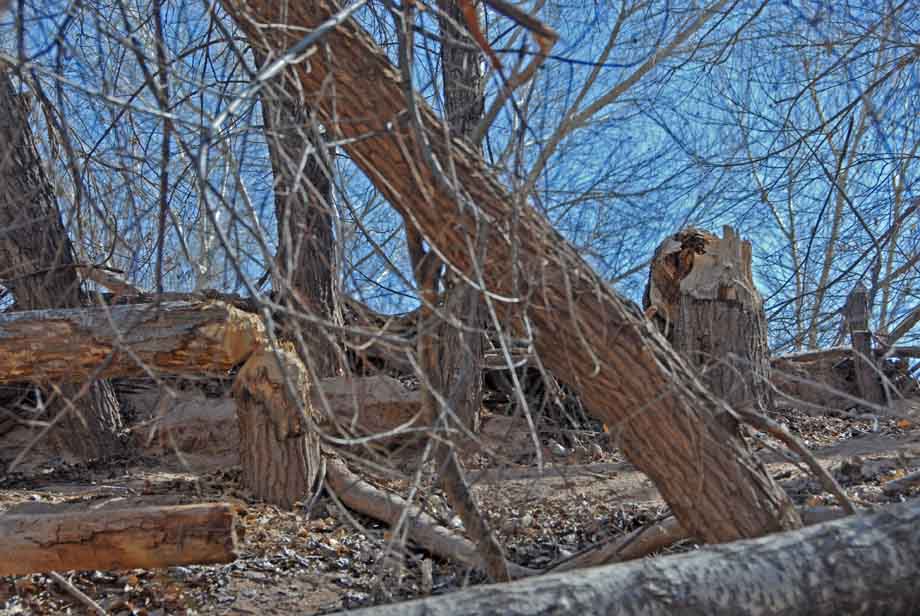
No doubt about it, only one critter in North America is going to do that to a tree, I was in a series of beaver ponds. And the beaver(s) had ingeniously arranged these ponds by taking advantage of the normal contours and hydrological features of the river. They did not make the classic bank to bank dam, but a series of small, porous dams. Cool.
I also routinely found floating, uprooted tules. The rhizome is edible and perhaps beavers had done this.
What should be patently obvious from these photos is that dams of this nature- very small in stature and porous- would not in the very least thwart a steelhead swimming upstream. Hell, these dams would not thwart my pet goldfish!!! But even dams in the 4-6 foot range are easily scaled by steelhead/salmonoids. It has been said before that the beaver taught the steeelhead how to jump. What should also be obvious is that without the beaver the riparian vegetation would be far thinner. Less habitat for all the insects, fish, amphibians, reptiles, and birds. Beaver do all this on the cheap and cost a lot less than expensive mechanized habitat/species restoration projects that are cumbersome due to their bureaucratic processes and the growing mistrust of all things "governmental" in this country. Its high time to repatriate the beaver with due respect to its place in American history and its future in this country.
Large, shallow rocky section before the beaver thickets on the right. I found some weird algae here
Now here is where things get all weird. As I moved out of the beaver thickets into a particularly wide, shallow, and rocky section of the river I noticed some strange submerged vegetation.
Looks almost like a tidal pool at the ocean, no? Those pinkish plants look like sea anemones almost, but they are not and I believe I have seen them before- if you know what they are let me know in the comments btw. But those brownish plants- looks a lot like kelp? But I am 15 miles from the ocean and at about 500 feet above sea level, this is fresh water. Take a closer look...
I don't know about you but that looks like a brown algae, except brown algae is almost exclusively salt/brackish water. I did a little internet sleuthing when I got home and although there are some rare filamentous types in isolated spots in California I could find no reference to a thallus forming freshwater brown algae in our fresh waters. So I contacted a person in the know when it comes to freshwater algae and lets just say the results are.... pending but may be very, very interesting. But I will be back to collect some samples for further analysis. It could be some weird type of cyanobacterial film or, tentatively, a new species. * Update it is a cyanobacteria Nostoc.
So all in all a good trip- I did not see a live beaver, but plenty of beaver-sign, and possibly discovered a new species. I can live with that.