Showing posts with label Sespe. Show all posts

Friday, October 3, 2014

Sespe Creek is Hurting in the Drought

Sespe Creek. Duane Nash 9/29/14
In the Ventura county back country is a special creek and wildlife area - the Sespe wilderness area. Not only is it undammed and relatively pristine compared to other southern Californian watersheds - the creek and it's surrounding watershed serve as critical habitat for California condors, desert bighorn sheep (following a successful reintroduction campaign), southern steelhead trout, arroyo toad, red-legged frog, western pond turtle, pacific lamprey, numerous threatened riparian/chaparral birds and many other species. This wilderness was also a last holdout for California grizzly and today still hosts black bear, puma, bobcat, coyote, and badger among other predators. And oh yeah, the story of beaver in California - and especially southern California - is intimately linked with the Sespe (from Lanman et. al. 2013):


A MaNIS search combined with
direct inquiries to California museums for pre-1923 Castor specimens located only a single
vouchered specimen. That specimen, a beaver skull (catalogued MVZ Mammals 4918)
was collected by John Hornung on 19 May 1906 on Sespe Creek, a tributary of the Santa
Clara River, Ventura County. Grinnell (1937) was hesitant to accept the provenance of
this specimen and placed a question mark by its location on his range map. Hornung, an
NHMLAC zoologist, had collected many specimens for the MVZ as well as the American
Museum of Natural History (Loomis 1901, Osborn 1910) and CAS (Howell 1923). Recently
digitized correspondence between Grinnell and Hornung has become available and settles
this longstanding question. When Grinnell wrote Hornung asking for further details regarding
the specimen; Hornung (1914:1-2) wrote back: “... In reference to the beaver, I will say
that I murdered the specimen in question 3 miles east of Cold Springs. I was on horseback
and saw on the river, enormously swollen as the date which you have [19 May 1906], what
appeared to me as a dead large dog surrounded by branches of a big stump. This stump
was swimming in the water, but anchored in a tangled mass of some kind of a vine. After
some maneuvering I could reach this animal with a stick. As soon as I touched it, it showed
its teeth, and I knew then what unexpected find I had made…A shot ended the animal’s
sufferings, and I secured the skull which you have…”. Hartman Cold Springs Ranch (34°
33’ N, 119° 15’ W) is located on upper Sespe Creek in the Sierra Madre Mountains at 1,025
m elevation and the creek along this stretch is quite low gradient, i.e. suitable beaver habitat.
Interestingly there is a Beaver Camp on the USGS GNIS at 1,000 m elevation about 1 km
east of Hartman Cold Springs Ranch, although its toponomastic origin is not known (Figure
3). In addition to the 1906 Sespe Creek beaver specimen, Hornung (1914:2) told Grinnell:
“There are still quite a few beaver in Southern California, myself being so lucky as to get
hold of one as late as Dec. 24, 1913, 3 weeks ago.”


Interestingly sporadic/anecdotal beaver sightings occurred right up until the 2000's. My own middle school biology teacher, Tim Peddicord, recalls seeing a beaver in Lions Creek ( a tributary to Sespe) in the 1960's. Whether or not the sightings are due to remnants of an original population or translocations that the CDFG did in the middle of the 20th century is anyones guess. And whether or not beaver are still holding out in isolated pockets of the Sespe is a (remote) possibility as well. I did notice some interesting and suggestive features on the Sespe when I recently went up and down it with GEOlocate.


Now most likely the suggestion of beaver activity in these pictures is just that - a suggestion - but there is the possibility that these features are the result of ancient beaver dams. The Sespe is known for deep pools that retain water during the dry season and which serve as refugia for fish and other aquatic organisms. Below is a picture of one such pool in wetter times after the last rainy season.

Such deep, permanent and snow melt fed pools (it is at about 3000') of course are the exact sort of place rainbow trout - or a beaver - can make a home of. And altogether the relative isolation (i.e. lack of conflict with agriculture/man), abundance of habitat, historical occurrence there, potential benefit to fisheries/other riparian species, low gradient, and history of species reintroduction in the area (desert bighorn sheep/California  condor) puts the Sespe wilderness high on my personal list of watersheds in southern California that beaver SHOULD be put back into.

Potential difficulties include the lack of political will on the part of the CDFW services to 1) finally admit they are native 2) come up with a comprehensive management/restoration plan.

And as noted earlier there are abundant predators in the Sespe so any reintroduction should be into spots with year round water/deep pools/hiding spots/alluvial banks for bank burrows.

And another difficulty for beaver in the Sespe, indeed all of California: Is this drought simply the new normal?


Now I know that is a disturbing and alarming thought but a controversial paper from Stanford scientists suggests that the stubborn high pressure ridge diverting storms away from California might be here to stay. Well at this point there are differing opinions and data - we shall see. Although it would not hurt to  plan for the worse.

But back to the Sespe. I got word from a friend on facebook that the pools were drying up and concentrating fish. Not just the small pools that may normally go dry... but the big, deep ones that generally always retain some water through the year. This was scary but, given that the Sespe is about 45 minutes away from me, I had to go check it out. Things did not look promising, when, as I drove through Rose Valley on the way to trailhead I noticed some failing pines (sugar pines?).


I honestly don't know if the trees are failing due to the drought or Japanes bark beetles - but as I was driving by a gun club I did not get out of my truck to investigate further. Depressing either way.

And when I got to Sespe Creek itself it has in fact, gone underground for long stretches.


The last picture is near the confluence of Lions Creek with Sespe Creek. For comparison below is a picture in the same area, in wetter times.


As I found out there were several deep pools that remained and offered hope for surviving fish and drinking water for the wildlife. I found one particularly nice, deep shaded pool after doing a little bushwhacking (and constantly checking for ticks/lions/bears).


And also the better known "Piedra Blanca pool" a well known swimming, diving pool was reduced to a grimy little wallow full of bullhead catfish and some unidentified fish (non-native) that kept biting and nibbling my hand when I put my hand in. I did not see any native trout but they were probably deeper amidst the rocks.


Anyways I have some youtube videos  I posted to my channel, feel free to subscribe and you will be my first subsribee!! I would post them here but blogger is giving me grief right now and not allowing that... 

Until I post again Cheers and Pray for Rain!!!


Black Bear paw print. Piedra Blanca Pool 9/29/14 Duane Nash


Support me on Patreon.
Like antediluvian salad on facebook.
Watch me on Deviantart @NashD1.Subscribe to my youtube channel Duane Nash.


Monday, January 6, 2014

A Southern Californian Riparian Stream and an Amazing Video on Southern Steelhead

I want to share some photos of stream I took recently. The photos are of the Portrero John Creek located in the Sespe wilderness of the Los Padres National Forest. Although the larger stream it flows into the Sespe is actually fairly dry in several areas this time of year the Portrero John Creek maintains consistent flows, even during the persistent drought we are experiencing in California. The Sespe watershed, as I have discussed before may have served as one of the last refugia of native goldern beavers in southern California prior to their extirpation. Reintroduction of beaver into such creeks makes a lot of sense in my opinion. You will notice good riparian vegetation- willows, cottonwood - and year round flow- thats all a beaver needs. In addition to the sometimes ephemeral flows in these mountains there are also abundant predators - cougars, black bears, coyotes, bobcats - that offer much challenge in terms of establishing populations. Also keep in mind the creek is at several thousand feet of  elevation and the area is often snow covered this time of year- but it has been a warm, dry winter so far in socal.


Also if there are any botanical people out there let me know what this plant I kept finding under oaks and pines is. I think it might be a spikemoss but I can't find any pics of types that look like it found in these parts of the Transverse Range.


And finally an awesome video by cal-trout about the challenges facing steelhead restoration with beautiful clips of several southern Californian streams and rivers. Enjoy.

Southern California Steelhead: Against All Odds

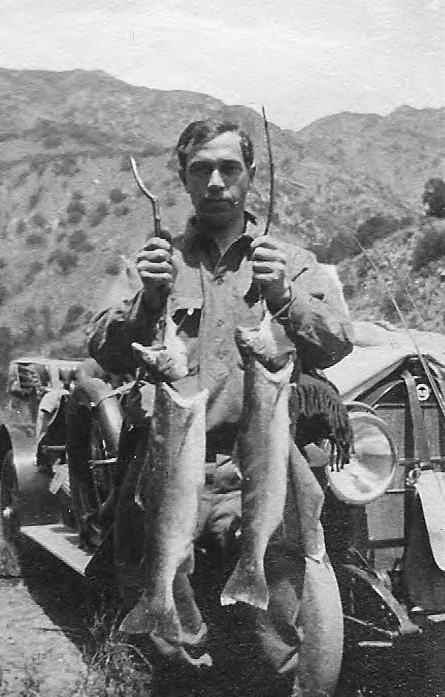
Steelhead. Sespe Creek. 1911
Steelhead. North of Fillmore  April 1983

Steelhead. North of Fillmore April 1917


Support me on Patreon.
Like antediluvian salad on facebook.
Watch me on Deviantart @NashD1.Subscribe to my youtube channel Duane Nash.

Wednesday, November 20, 2013

Reclaimed Water for the Win?


Looks like a nice little meandering river, no? Nice riparian vegetation- loads of willows, cottonwoods, sycamores- good flow for a southern Californian stream deep into the fall before any rains have commenced. Surely such an inviting scene is miles away from the machinations of modern man. But that little road way may tip you off otherwise...

What you are looking at is a section of Conejo creek downstream from the Hill Canyon Wastewater Treatment Plant of Thousand Oaks. Of course I have mentioned this watershed before. Conejo creek has received some press recently due to the revelation that the federally protected southern steelhead has begun to recolonize these waters. The cities of Thousand Oaks and Camarillo both discharge treated wastewater into the creek. And in light of the fish's presence in the creek both municipalities may now be required to sustain these discharges in order to maintain the habitat. And this is much to the ire of at least Camarillo, because that city had begun construction of a pipeline to use their reclaimed water for agriculture (probably sod farms as I don't think reclaimed water can be used for food crops).

And this whole debate is one which we have visited upon before: In a landscape that has historically been robbed of water flow through dams and diversions, is it now our obligation to recoup some of the  losses by taking advantage of outflow from wastewater treatment plants? I know it is not a pleasant thought, concentrating wildlife restoration efforts in essentially treated sewage. But as I said before, in a water parched landscape, beggars can't be choosers. And ultimately, it is not our choice to make- wildlife is already making the choice to live in habitats made possible through reclaimed water discharge- such as the steelhead recolonizing Conejo creek or the waterfowl I photographed in some of the tanks for the treatment facility in the picture below.


And I mean, it really is a nice looking stream when you get over the "treated sewage" aspect of it...


Of course all of this talk of treated effluent begs the question: should we concentrate beaver restoration in these areas in southern California? Well I would say YES! YES!! and more YES!!!

But let me buffer my argument more with this line of reasoning. To reestablish beaver they need to get over the predator hump. MartinezBeavers talked about this issue recently here. While beaver have been extirpated from many parts of their former range, their natural predators-cougars, bobcats, coyotes, bears, wolves- have done quite nicely in the meantime. Jeff Baldwin of Sonoma State addresses this very real issue of the problem of beaver reintroduction in predator saturated lands. It becomes less to do with stream slope gradient/vegetation type and more to do with how will this beaver transplant survive in small streams before it can build dams to survive predation? There is a real potential for loss in restoration efforts especially in arid lands with small streams and abundant predators. So the real question becomes how do we maximize our chances of successfully reintroducing beaver into these lands? Well we need to look at beaver restoration as essentially a war- there will be heavy casualties beavers will absorb, no doubt about it, from people and predators.

Okinawa beachhead. 1945. wiki
But if we utilize the areas of deepest water and highest flow- often man made reservoirs, dams, and water reclamation outflows- we will stand the greatest chance of establishing beachheads. And from these beachheads beaver can then spread across the whole watershed.

N. Matijilla Creek. Los Padres Wilderness

Middle Lions Camp. Sespe Wilderness
Above are two places I would love to see beaver reintroduced. The north fork of Matijilla creek is a tributary of the Ventura river and still has steelhead while Middle Lions camp also has a stream in it with steelhead. In the case of Lions camp I have it on good record that an acquaintance of mine, Tim Peddicord a retired biology teacher, spotted a beaver there in the 1960's. Additionally numerous other anecdotal reports of beaver in the Sespe watershed suggest that this area was a final stronghold for beaver in southern California.

However the Sespe wilds might not be the ideal spot to reintroduce beaver initially, as appealing as it may seem. That name, Lions camp, is no joke- there are lots of cougars out there, and bear, and coyote, and bobcat. The flows might be low or the pools just not deep enough to establish beaver in high enough densities to get over the predator hump out in the Sespe.

But how about a place like this:

Santa Clara River Estuary
Although the lower Santa Clara river runs dry due to the Freeman Diversion the estuary forms a veritable lake due to discharge from the Ventura wastewater treatment plant. Dense beds of tules and acres of willow thickets would be ideal forage. No cougars or bears here. Establishing a viable population would be possible and from here intrepid beavers could spread up into the entire watershed or be transplanted by humans to other areas in the watershed.

We just have to get over the "icky" reaction to treated wastewater- the wildlife already has.

Conejo Creek
Support me on Patreon.
Like antediluvian salad on facebook.
Watch me on Deviantart @NashD1.Subscribe to my youtube channel Duane Nash.