Monday, March 17, 2014

Conservation/Restoration in the 21st Century: More Complex and Critical than Ever

Blogging is a funny and interesting thing. One thing that I have noticed is that when you plug into a community of like-minded bloggers that overlap in subject matter an interesting phenomena occurs where a type of hive mind, or congruence of ideas develops. It is almost like some type of subconscious  meta-brain is at work creating a general thrust of thought in a significant direction. I have experienced this on my paleontology themed blog Antediluvian Salad several times and a similar event occurred with regards to conservation/restoration efforts spurred on by two blogs I follow closely.

The first blog is one that, if you follow this blog, you no doubt know of: Heidi Perryman's Martinez Beavers- the veritable CNN of all things beaver. The post I have in mind is from several days ago entitled Save-Everythings, Save-Somes and Save-Ours. A very interesting post and one that touches upon a lot of crucial issues in contemporary conservation/restoration work. Starting with a critique on how certain groups misunderstand/misapply beaver devices/trapping Heidi dovetails into a discussion on the difference between Save-Ours, Save-Somes, and Save-Everythings and how her group has transitioned between these different groups in her beaver saga. At first she was a Save-Ours, concerned with the Martinez beavers. When this group was safe she transitioned to more of Save-Some until now she calls herself "a hugger who has learned to camouflage herself as a Save-Some." Of the three groups, Heidi maintains, it is the Save-Everythings that face the most stony path- they face a daunting challenge, ridiculed for the most part and said to be "disconnected" from the real world. Scientists and professional wildlife/forestry agents will almost unanimously align themselves with the Save-Some line of thought for fear of the Hugger label. A particular telling example Heidi recounts when a colleague sent Heidi video of a beaver dam being blown up and Heidi responded emotionally to which said colleague replied "that I should be able to laugh at these things. I shouldn't act so upset or people would accuse me of being a hugger." 


As a little ironic aside, the disparaging phrase of hugger derived from the phrase tree-hugger, popularized as an insult to old-growth redwood activists, is maybe not applicable towards beaver defenders. Because beaver, you know, are chopping down all those beautiful trees remember (wink, wink)?

The other post is one from Rick Merill's Coyotes, Wolves and Cougars...... forever! blog- a very prolific blog emphasizing predator rewilding/conservation in North America. Rick wrote a very telling and illuminating piece on conservation but be forewarned the second part of the piece is very disturbing and graphic: link. The first half of the post is timeline of some of the major milestones in conservation law for this country- largely bipartisan and largely popular when enacted. The second half of the post details an undercover probe into the coyote/wolf derby of Salmon, Idaho. Posing as hunters in the competition themselves the writers document a community beset with predator eradication, xenophobia, racism, gun-worship, anti-government, anti-liberal, and anti-HUGGER sentiment is brought to light. The community as a whole appears complicit in illegal hunting and trapping, as well as killing wild canids as painfully as possible. The ironically titled, Idaho for wildlife, sponsors the event and booooy do they have a dozy of a website, essentially just a shill for predator eradication with loads of self-citations and just bologna.

Here are some depressing excerpts:


Hunting for food is one thing, and in some cases
 hunting helps to keep overabundant species like
 deer in ecological check. But the reason we have too
 many deer in the US in the first place is simple: the
steady decline of big predators like the mountain lion
 and—you guessed it—the wolf. The fact is that we
 need wolves in ecosystems. So why a killing contest
 to rid the land of them?
After digging into the wolf-hate literature featured on
 Idaho for Wildlife’s website, I wondered whether the
 residents of Salmon were looking to kill wolves out
 of spite. They hated these creatures, and I wanted
 to understand why.
Besides killing wolves, one of the group’s core
 missions, according to its website, is to “fight against
 all legal and legislative attempts by the animal rights
 and anti-gun organizations who are attempting to take
 away our rights and freedoms under the Constitution
of the United States of America.” The website also
suggested that media coverage of the event was
not welcome. The only way I’d be able to properly
 report on the derby, I figured, was to go undercover
 as a competing hunter. So I showed up in Salmon
 a few days before the event, paid the $20 sign-up
 fee, and officially became part of the slaughter.
Going further into the belly of the beast that is the Salmon predator derby:


“Gut-shoot every goddamn last one of them wolves,”
 Cal told us. He wished a similar fate on “tree huggers,”
 who, in Cal’s view, mostly live in New York City.
“You know what I’d like to see? Take the wolves
 and plant ’em in Central Park, ’cause they impose
 it on us to have these goddamn wolves! Bullshit!
 It’s said a wolf won’t attack you. Well, goddamn,
 these tree huggers don’t know what. I want wolves
to eat them goddamn tree huggers. Maybe they’ll
 learn something!”

We all raised a glass to the tree huggers’ getting
 their due. I fought the urge to tell Cal that I live in
New York part-time, and that in college Natalie
trained as an arborist and had actually hugged
trees for a living. Her brother, who is 31 and
studying to be a lawyer in Boise, Idaho, had warned
 me about the risks of going undercover when I
 broached the idea over the phone. As a representative
for the nonprofit Western Watersheds Project, which
has lobbied for wolf protections, he’d attended numerous
public meetings about “wolf management” in communities
 like Salmon. “Salmon is the belly of the beast,” he told
me. “There is not a more hostile place. It’s Mordor.”
Brian’s former boss at the Western Watersheds Project,
 executive director Jon Marvel, has received death threats
 for speaking out in favor of wolves and against the
 powerful livestock industry. Many pro-wolf activists
across the American West, especially those who have
 publicly opposed the ranching industry, have reported
similar threats and acts of aggression—tires slashed,
 homes vandalized, windows busted out with bricks in t
he night. Idaho for Wildlife’s opinion on the situation is
made clear on its website: “Excess predator’s [sic
] and environmentalists should go first!”

Despite the "overpopulation" of wolves in Idaho not a single wolf was killed and only one seen in the derby, 21 coyotes killed. And with the delisting of wolves in several states peer reviewed science has been critical of this decision.
Now with these two blog posts in mind I want to go a little further. Beaver and wolf are both emblematic and native species to much of North America. Although one is a predator and one is a herbivore they both play pivotal roles in the ecology and landscape to which they are native. Both have attributes of a keystone species. They are both territorial and will expand into new territories when capacity is met. Both species have been largely exterminated from large areas of their former range. And both species are rife with accounts of pseudo-science, half-truths, and assertion science. And both species spell out some of the significant battle-lines drawn in how North America approaches its wildlife and wildlands.
What is most interesting to me is how the wolf has become a symbol of government over reach. How frustration on how this county is run, the role of government, is making a pariah out of recovering wolves. It is not too hard to imagine how beaver restoration can befall a similar fate.
And it is here that I want to go back to the Perryman post on what level of conservation do you support. Are you a middle of the roader Save-Some or do you want to take up the difficult task of Save-Everythings? 
Let us look at this question from the perspective of watershed health, specifically the beleaguered watersheds of California and specifically southern California which is our main subject. Hammered by diversions, dams, invasive species, agricultural and urban withdrawals, runoff and pollution- it is hard to call the damage done to these watersheds "middle of the road". Following from this, I argue, the solution to rehabbing these systems should not be "middle of the road" and therefore befitting more of a Save-Everything approach than a Save-Some approach. If we take the southern steelhead as a proxy for the health of the watershed, and these populations are conservatively 1% of their former population- then a middle of the road Save-Some approach is clearly not appropriate to this level of devastation. 
The point of a Save-Everything mindset is not that you will actually, you know, save everything. We will probably never see the historic level of steelhead, 10,000 or more strong, in our rivers. We will probably lose some species that are very near to extinction or extirpation- no matter how hard we strive for restoration. My point is that a middle of the road, Save-Some approach, is not doing the job and has not done the job in our watersheds. Unfortunately, for fear of being called a name- a Hugger -people in the know, people who know the science- DFW, game wardens, even conservationists - are always a little tentative to get too radicalized and go to the Save-Everything camp. Big business is always going to find it's voice. Politicians- depending on who they are trying to appeal to -are always going to find their voice. Will restoration ecology/conservation find it's voice? Will it take a back seat to other interests or insist on riding shot-gun?
Business and industry come and go. Money comes into a place and moves on. Look at Detroit. But if you let significant economic interests lay siege to the lifeblood of any landscape- it's water -then after that industry moves on, and they always do, now you are left both jobless and with a poisoned landscape. 

Support me on Patreon.
Like antediluvian salad on facebook.
Watch me on Deviantart @NashD1.Subscribe to my youtube channel Duane Nash.

Saturday, March 8, 2014

The Levee Broke... Beaver Historically Native to Most of California


Led Zeppelin- When the Levee Breaks (Play Loud)

If it keeps on raining the levee is going to break....

Yes what started as a drip, then a trickle, growing into a flow, is now a torrent. When I first started this blog there was the groundbreaking work on beavers in semiarid eastern Oregon to rehabilitate streams and steelhead/salmon habitat: Cheap and Cheerful Stream restoration with Beaver?  Drought stricken New Mexico decided to get proactive about a comprehensive statewide beaver management program. Then there was the awesome and timely paper on beaver ecology, management, and conservation of beaver in dryland stream habitats (Gibson/Olden 2014). The devastating California drought is waking people up about water conservation. Now there is huge interest in the salmonid/beaver workshop in Santa Barbara- the event ultimately selling out (for which I had to pull some strings just to get a pass myself). And now finally the paper which I have been waiting for for well over a year:

Current and Historic Range of Beaver in CA. CDFW Lanman et al

The Historical Range of Beaver (Castor canadensis) in Coastal California: A Review of the Evidence
(Christopher W. Lanman, Kate Lundquist, Heidi Perryman, J. Eli Asarian, Brock Dolman, Richard B. Lanman, Michael Pollock) California Fish and Game 99(4): 193-221 (2013)

Yes, that levee just broke. If you thought beavers in southern California is crazy talk, that there is not enough water for them or suitable habitat, that they will harm steelhead- well time to just think again and get yourself on the right side of history. The beaver zeitgeist is here and is not slowing down.

From the discussion section of the paper:


There has been a tendency to underestimate the influence of beaver on ecosystems
(Pollock et al. 1994). The presence of beaver has been shown to increase bird, fish,
invertebrate, amphibian and mammalian abundance and diversity (Naiman et al. 1988, Rosell
et al. 2005). As an integral part of the ecosystem of historic California, beaver may have
benefitted many threatened species. Colonization of southern California streams by beaver is
associated with increased riparian habitat, especially dense shrubby willow, which is critical
habitat for federally endangered southwestern willow flycatcher (Empidonax traillii extimus)
(Finch and Stoleson 2000) and least Bell’s vireo (Vireo bellii pusillus) (Muller-Schwarze
and Sun 2000) populations. There is evidence that beaver dams provide important refugia
for endangered California red-legged frogs (Rana draytonii) (Alvarez et al. 2013) and
western pond turtles (Actinemys marmorata) (Alvarez et al. 2007, Lovich 2012). Similarly,
beaver ponds and bank burrows appear to provide refugia for endangered tidewater goby
(Eucyclogobius newberryi) (USFWS 2005). In a historical ecology study of the San Gabriel
River in southern California, it was estimated that since 1870, 86% of historical wetlands
have been lost especially in the lower floodplain (Stein et al. 2010). In contrast, in the tidal
Copper River delta beaver activity has been shown to increase freshwater surface area and
to prevent seasonal drying of the floodplain (Cooper 2007). Allowing beaver to recolonize
their historic range could reverse the ongoing loss of wetland habitat in California’s coastal
watersheds.


Documenting that beaver were historically extant in California’s coastal streams
may have important implications for declining salmonid populations. Pollock et al. (2003)
reviewed reports of beaver “perennializing” formerly seasonal streams, and Tappe (1942)
noted summer flows in several streams in northern California increased after beaver
colonized upstream reaches. Gallagher et al. (2012) reported on limiting factors for coho
salmon (Oncorhynchus kisutch) populations in coastal northern California streams and
concluded that winter habitat was critically important, recommending adding substantial
amounts of large wood to increase pool habitats, improve stream shelter in high winter
flows, and reconnect the stream to floodplain habitats. Beaver impoundments also increase
winter habitat, and whereas large woody debris may be associated with coho salmon smolt
production (SPP) of 6-15 individuals, SPP per beaver dam ranges from 527 to 1,174 fish,
indicating that promotion of beaver populations may have an 80-fold more positive impact
(Pollock et al. 2004). Salmon from Alaska to Oregon have clearly evolved in sympatry
with beaver and these anadromous fish ascend coastal streams with beaver dams, the latter
often overtopped or breached by high winter flows. Coho salmon can jump dams as high
as 2 meters (Bryant 1984, Powers and Orsborn 1986). Gard (1961) showed that rainbow
trout (Oncorhynchus mykiss) can also cross beaver dams and in both directions, with some
accounts of trout crossing a series of 14 dams (Pollock et al. 2003). Hood (2012) reported
that beaver dams tripled juvenile Chinook salmon (Oncorhynchus tshawytsha) survival in
brackish tidal marshes in the Skagit River delta of Puget Sound. Today California’s coastal
beaver are widely regarded as the non-native survivors of twentieth century translocations,
and when they cause flooding problems or fell trees, depredation permits are often provided.
Understanding beaver as native to coastal ecosystems may impact this decision-making.

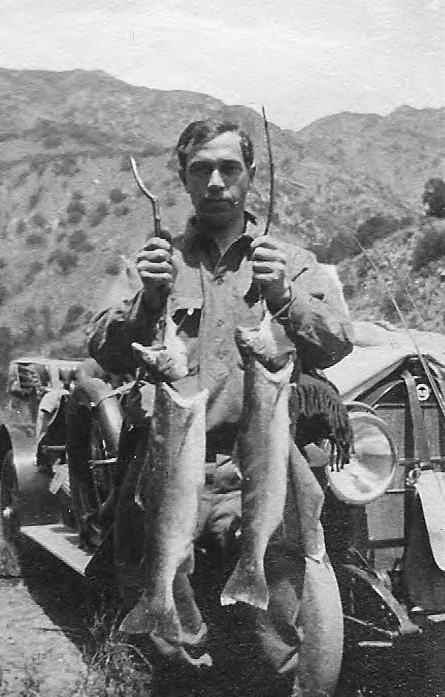
Fillmore Fish Hatchery. Rainbow Trout. author
Based on the results of our study, coupled with the recent evidence of historic beaver
in the Sierra Nevada (James and Lanman 2012, Lanman et al. 2012), and the long-established
nativity of beaver to the Central Valley, the Colorado River and California’s northern rivers
(Tappe 1942, Grinnell et al. 1937), we conclude that the historic range of beaver included
most of California, except the streamless portions of the southern deserts (Figure 4). We
consider the historic presence of beaver in the perennial streams in California’s deserts (e.g.,
the Mojave River) unverified, but highly probable, given their current presence in these
systems (Lovich 2012) and the historic and current presence of beaver in similar desert
streams in Arizona (Allen 1895).


Beaver Dam. Santa Ynez River. Author


Support me on Patreon.
Like antediluvian salad on facebook.
Watch me on Deviantart @NashD1.Subscribe to my youtube channel Duane Nash.

Wednesday, February 19, 2014

As the Beaver Zeitgeist Approaches....

From Wikipedia: The Zeitgeist (spirit of the age or spirit of the time) is the intellectual fashion or dominant school of thought that typifies and influences the culture of a particular period in time.

It seems as if beaver restoration/awareness is one of those activities where the saying 3 steps forward, 2 steps back is very apropo. On one side you have the robust scientific body of evidence that beaver benefit watershed, enhance fisheries, negate drought-flood-channel incision/erosion, increase biodiversity, and sequester carbon. Management practices, i.e. living with beavers by being smarter than them, with the utilization of flow control devices, beaver deceivers, and mesh-wire to protect trees has also revolutionized the game. And for the first time beaver management can be both pragmatic, co-habitable and practical. But seemingly in lockstep with the increasing realization of these benefits are outdated management practices- dynamiting dams, trapping, killing, kill quotas- and the dilemma of, what I like to call science by assertion. 

Here is an example of science by assertion, more or less paraphrased from a discussion on beaver restoration in New Mexico. Beaver dams occur on the river upstream from my property.  We are not seeing the surface flows we once did. I can't get my historical allotments, water my crops, etc etc... the beaver dams took away the water and it is all held back behind their dams. Get rid of the beavers...

At best this is a hypothesis, albeit a hypothesis not supported by the vast amount of data regarding hyporheic exchange, water tables, aquifers, and the nature of ephemeral flows in arid watersheds. Truth be told the above statement is in fact a great example of correlation does not imply causation. In reality these lessened surface flows would be there with or without the beavers and are a result of the drought stricken west, subsurface pumping, and water diversion. If anything, beaver will allow longer sustained flows in rivers/creeks of an ephemeral nature.

Never the less despite recalcitrant outdated notions that people hold onto like cherished icons of a dying faith the beaver movement is gaining grounds slowly but surely.

Senators Seek Plan to Help Bring Back the Beavers and Protect Wetlands


Wildlife biologists contend beavers could be the most low-tech, inexpensive answer that drought-plagued New Mexico has for storing up precious water and rescuing dwindling wetlands— but some of the animals are still killed every year by people who consider them nuisances.

The state Senate is considering a memorial sponsored by Sens. Tim Keller, D-Albuquerque, and Bobby Gonzales, D-Taos, asking several agencies to develop a statewide beaver-management plan to rein in conflicts between property owners and unwanted animals and to support populations where beavers are needed. Senate Memorial 4 passed the Senate Rules Committee Thursday and is scheduled to be heard next in the Conservation Committee.
“I’d like to see New Mexico craft an intentional beaver-management plan like Utah has,” said Bryan Bird, Wild Places Program director for the Santa Fe-based nonprofit WildEarth Guardians. “It would be a solution to a lot of problems. Right now, there’s no logic to how we manage beavers.”

Of course it is not too hard to make the leap from New Mexico- semiarid, drought stricken- to California (especially socal)- also semiarid and drought stricken. I think you can connect the dots. Let's hope that New Mexico proceeds and California does not lag too far behind (like Bakersfield).


In fiscal year 2011, Wildlife Services killed or euthanized more than 27,000 nuisance or injured beavers in 44 states and relocated 177. In New Mexico, Wildlife Services has killed or relocated an average of 30 beavers a year. In 2012-13, licensed trappers also harvested 121 beavers.
Beavers lived in all perennial waters in New Mexico until the late 1880s. Their numbers steadily declined due to trapping, development, livestock grazing and loss of habitat.
Without beavers, the ponds that helped store up water on many stream systems dwindled, according to another recent study on the ecological benefits of beaver dams, conducted by New Mexico State University researchers. The study found only 40 active beaver dams on streams on public lands in the state in 2013, according to Jennifer Frey, an associate professor and one of the study’s authors. She said beaver were “functionally extinct” in the state because “they are so sparsely distributed that they are not able to perform the vital ecosystem services that would improve the health of our streams.”
A 2011 report from the state Department of Game and Fish, the USDA and the U.S. Fish and Wildlife Service said there was evidence of beavers on 2,200 miles of riparian habitat in New Mexico. Population estimates for beavers in the state range from 5,254 to 11,676 animals.
You gotta say, that is some of the best news in a while- it looks like some people are listening.
And to top that one is some real science, just published in Aquatic Conservation: Marine and Freshwater Ecosystems

Now that is a title of paper I can sink my teeth into.


ABSTRACT

  1. After near-extirpation in the early 20th century, beaver populations are increasing throughout many parts of North America. Simultaneously, there is an emerging interest in employing beaver activity for stream restoration in arid and semi-arid environments (collectively, ‘drylands’), where streams and adjacent riparian ecosystems are expected to face heightened challenges from climate change and human population growth.
  2. Despite growing interest in reintroduction programmes, surprisingly little is known about the ecology of beaver in dryland streams, and science to guide management decisions is often fragmented and incomplete.
  3. This paper reviews the literature addressing the ecological effects and management of beaver activity in drylands of North America, highlighting conservation implications, distinctions between temperate and dryland streams, and knowledge gaps.
  4. Well-documented effects of beaver activity in drylands include changes to channel morphology and groundwater processes, creation of perennial wetland habitat, and substantial impacts to riparian vegetation. However, many hypothesized effects derived from temperate streams lack empirical evidence from dryland streams.
  5. Topics urgently in need of further study include the distribution and local density of beaver dams; consequences of beaver dams for hydrology and water budgets; and effects of beaver activity on the spread of aquatic and riparian non-native species.
  6. In summary, this review suggests that beaver activity can create substantial benefits and costs for conservation. Where active beaver introductions or removals are proposed, managers and conservation organizations are urged to implement monitoring programmes and consider the full range of possible ecological effects and trade-offs.
Copyright © 2014 John Wiley & Sons, Ltd.
This paper essentially synthesizes all the peer reviewed knowledge we have about beaver in xeric habitats- very pertinent to my quest here of course. The authors take a very conservative, but I would not say negative, position on when, how, and where beaver belong- and this is a very rigorous approach as there are many mitigating factors- beaver effects on non-native vegetation, animals etc etc that should be considered. And truth be told beaver advocates, including myself,  sometimes portray beaver as a bit of a panacea- but things are complicated, especially highly human modified watersheds. But the more info the better and the timing of this paper is very promising in terms of the increasing pace of beaver restoration in arid watersheds!! Exciting times!!!

Unfortunately the paper is behind a paywall, if you want a copy just shoot me an email at duanen8@gmail.com


Santa Clara River @ Santa Paula. Duane Nash
Also, since we talk a lot about salmonids (trout, steelhead, salmon) let us remind ourselves we are in a drought and we need to protect these precious, unique, and valuable anadromous fishes.

Saving California's Salmon During a Severe Drought

and don't forget the Salmonid Restoration talks in Santa Barbara this March with a special program on Beavers!!!


Carson Jeffres (c)

Support me on Patreon.
Like antediluvian salad on facebook.
Watch me on Deviantart @NashD1.Subscribe to my youtube channel Duane Nash.

Wednesday, January 29, 2014

As the Drought Bleeds On... like Water from a Stone

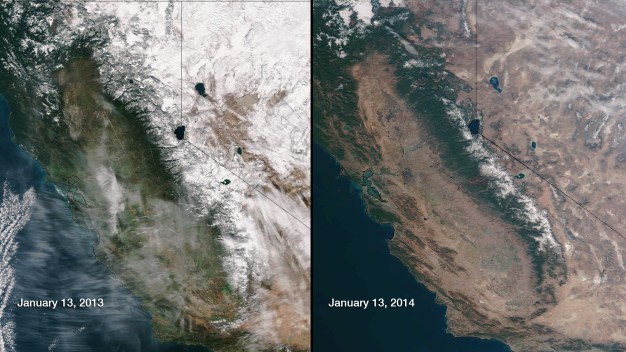
Yep, things are pretty bad here in California with quite possibly the worst drought in California's recorded history pummeling California and other parts of the west right now. A picture is worth a thousand words...
NOAA/NASA
To the left is California on January 13, 2013- a drought year but not as bad as this year on the right. In addition to the lack of Sierra snowpack, the lack of green is pretty startling as well in the picture. Yep, if we don't get any water soon there is going to be dramatic changes a-foot in terms of how this state treats it's water resources. Agriculture, golf courses, water recreation, front lawns- this state may have a wholly different appearance in the coming years if, as some are already suspecting, this drought is actually not a drought at all but simply the new normal...

And if you get out and hit boots to the ground you can easily see the crippling effects this drought is already having on the environment/water resources. Remember when I took a little beaver safari to the beautiful Santa Ynez a couple of months ago? Well I have not been there in some time but I have heard large portions of the river are dry and that, as the photo below of Bradberry dam attests, Lake Cachuma has dropped so low water outflow to the Santa Ynez is cut off.

Bradberry Dam @ Lake Cachuma (lake side facing us)
Let us hope the beaver population of the Santa Ynez, one of the best in socal, finds a way to get through this massive drought. Here is more on Cachuma lake, a reservoir that provides drinking water for much of Santa Barbara county.

Closer to home in Ventura county things are no better. On hikes through the chaparral hills I am noticing many of the normally bomb-proof plants simply browning up and failing. Scrub oak, manzanita, ceanothus- plants which thrive in our semiarid, 12-14 inches of rain environment- still need those 12-14 inches of water to survive! On the Oxnard plain in Ventura county where I live- a major agricultural hub- many of the normally bursting strawberry fields are simply being turned over and allowed to go fallow. Farmers are not getting the seasonal rains and as the aquifer plummets they may no longer be getting the historical pumping allotments, unsustainable as they were, that let them grow blueberries in the desert.

Things are bad for our friends the salmonids not just in southern California but throughout the whole state where some stocks of Coho salmon in central/northern California may go extinct.


Yep it is scary times. I would attempt to put a positive beaver spin on it- but beaver only work as water storage devices where there is at least some water there to begin with...

Never the less we can still hope. I recently hiked up the Matilija Creek in Ventura county. You know the one infamous for the dam that has that graffiti on it? Well the normally perennial creek was dry, until I got up higher in the drainage and found some water still flowing. Hiding out in one of the pools- a rainbow trout. Surviving trout give me hope- where trout live, maybe beaver can too...


Support me on Patreon.
Like antediluvian salad on facebook.
Watch me on Deviantart @NashD1.Subscribe to my youtube channel Duane Nash.


Monday, January 6, 2014

A Southern Californian Riparian Stream and an Amazing Video on Southern Steelhead

I want to share some photos of stream I took recently. The photos are of the Portrero John Creek located in the Sespe wilderness of the Los Padres National Forest. Although the larger stream it flows into the Sespe is actually fairly dry in several areas this time of year the Portrero John Creek maintains consistent flows, even during the persistent drought we are experiencing in California. The Sespe watershed, as I have discussed before may have served as one of the last refugia of native goldern beavers in southern California prior to their extirpation. Reintroduction of beaver into such creeks makes a lot of sense in my opinion. You will notice good riparian vegetation- willows, cottonwood - and year round flow- thats all a beaver needs. In addition to the sometimes ephemeral flows in these mountains there are also abundant predators - cougars, black bears, coyotes, bobcats - that offer much challenge in terms of establishing populations. Also keep in mind the creek is at several thousand feet of  elevation and the area is often snow covered this time of year- but it has been a warm, dry winter so far in socal.


Also if there are any botanical people out there let me know what this plant I kept finding under oaks and pines is. I think it might be a spikemoss but I can't find any pics of types that look like it found in these parts of the Transverse Range.


And finally an awesome video by cal-trout about the challenges facing steelhead restoration with beautiful clips of several southern Californian streams and rivers. Enjoy.

Southern California Steelhead: Against All Odds

Steelhead. Sespe Creek. 1911
Steelhead. North of Fillmore  April 1983

Steelhead. North of Fillmore April 1917


Support me on Patreon.
Like antediluvian salad on facebook.
Watch me on Deviantart @NashD1.Subscribe to my youtube channel Duane Nash.

Going Cuckoo for Beaver

(c) PhotosbyJoe
I want to introduce you to a bird, a bird you may not have even known existed in southern California- the Western Yellow Billed Cuckoo, Coccyzus americana. Yes southern California actually has a cuckoo and the western distinct population segment is what we are talking about here because it has different habitat requirement than the eastern population. It is a secretive bird, predator of large insects and small vertebrates, has a distinct call, and is one of the latest arriving migrants to America from its wintering grounds in South America. It lives in deciduous woodlands and, specifically for the western population segment, riparian habitats. Areas with stands of cottonwoods, willow, and sycamore. Sounds like it prefers the habitat of something else we talk a lot about here that happens to be the namesake of this blog. And surprise, surprise it is a rare bird. So rare in fact that the U.S. Fish and Wildlife Service is moving to list this bird as a Threatened Species under the Endangered Species Act (ESA). And here is what the American Bird Conservancy group has to say about that:


"The draft rule only proposes to list the species as threatened rather than as endangered, and doesn’t address the threats or propose more effective conservation measures such as removing cattle from riparian areas and restricting the use of pesticides in adjacent agricultural areas,” said Steve Holmer, senior policy advisor with American Bird Conservancy.

But wait there is more:

"Federal agencies must address water diversion and grazing policies that are disastrous to the cuckoo. They need to reverse direction, stop the degradation, and develop a plan to restore riparian areas and regrow lost Yellow-billed Cuckoo habitat," Holmer added.

Ok so it appears this bird has a lot of obstacles in its way. Getting agriculture to go pesticide free, not likely for big agriculture. Removing cattle from riparian habitats, again gonna be a tough one. But that last sentence: "They need to reverse direction, stop the degradation, and develop a plan to restore riparian areas and regrow lost Yellow-billed Cuckoo habitat." That last bit about restoring and regrowing riparian areas yeah beaver can take care of the that part. The pesticides and the cattle- that is difficult but restoring the habitat beaver can go a long way towards that end.

Hopefully you are seeing a theme here. Steelhead salmon, yellow billed cuckoos, western pond turtles, red-legged frogs, willow flycatchers and even the beaver themselves- it is not really about any one of these species individually. It is about finding the most economically sound, viable, repeatable and observable tool that can at least give all of them a fighting chance- let the beaver do the work of habitat restoration for us.

The U.S. Fish and Wildlife Service is taking public comments on the listing of the western distinct population segment of the yellow billed cuckoo until February 24, 2014. I suggest you drop by and give them your thoughts.

Ventura River riparian forest

Support me on Patreon.
Like antediluvian salad on facebook.
Watch me on Deviantart @NashD1.Subscribe to my youtube channel Duane Nash.